You are four months into your first year as a junior doctor. The shift has barely begun, but the Emergency Department is already overflowing. You’re still catching up on handover notes when the resus buzzer sounds.
A 58‑year‑old man, Mr. Harris, is rushed in with crushing chest pain. He’s pale, clammy, and visibly terrified. You join the team in Bay 1, taking the history while the nurse attaches the ECG leads. His words are short, broken by breathlessness.
Before you can finish your assessment, the monitor alarms.
Ventricular fibrillation.
Mr. Harris collapses back onto the trolley, unresponsive.
“Start CPR,” the senior doctor says, and suddenly all eyes turn to you.
Your stomach tightens. You’ve trained for this. You’ve passed the exams. You’ve practised on manikins. But this is different. This is a real human being whose life now depends, in part, on your hands.
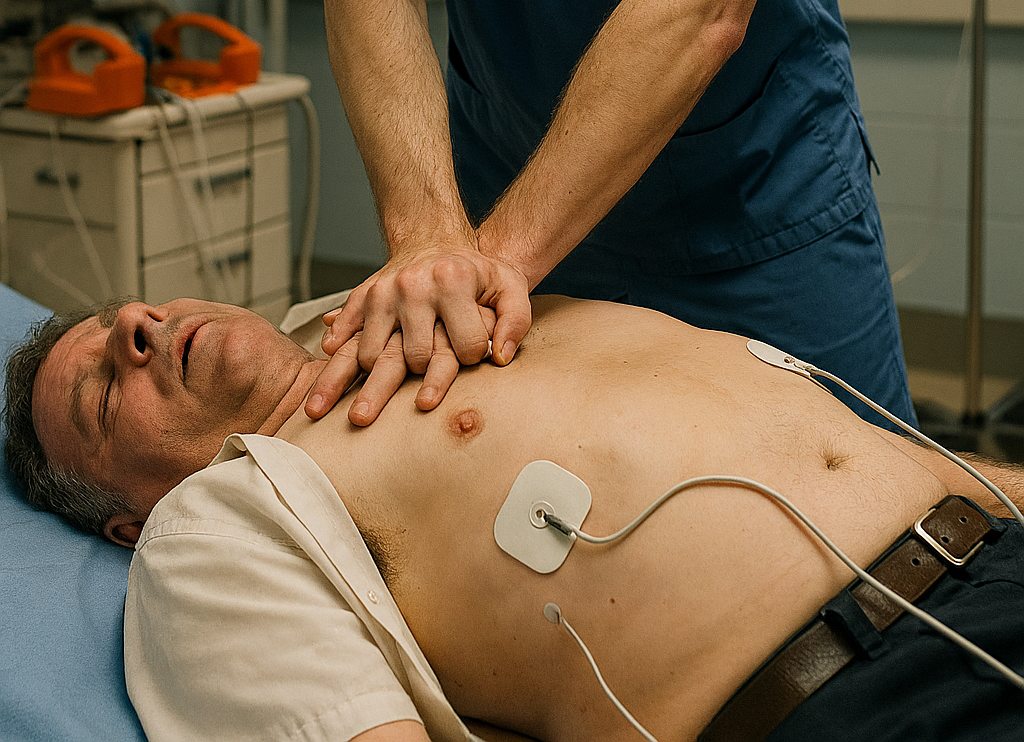
You climb onto the step and begin compressions.
Hard. Fast.
Your arms ache almost immediately.
The world narrows to the rhythm beneath your palms.
The crash team floods the room. Someone prepares the defibrillator. Someone else draws up adrenaline. You keep going until you’re relieved, stepping back breathless, sweat gathering at your collar.
A shock is delivered.
Another round of CPR.
Another shock.
Then – a pulse.
Weak, but present.
The team moves quickly to stabilise him for transfer to the cath lab. You stand at the edge of the bay, heart still racing, watching the trolley disappear down the corridor.
Only when the room falls quiet do you realise your hands are shaking.
Later, in the staff room, the adrenaline fades and the weight of the moment settles in. You replay every second — what you did, what you could have done, what might have happened if things had gone differently. You know that not every arrest ends with a pulse. You know that some will stay with you long after the shift ends.
This is the reality of medicine: moments of triumph, moments of loss, and the emotional imprint of both.
i will reassure myself that whatever happens that what i tried was my best and was the most i could do at that moment even if it isnt a complete sucsess.
I think its important not to think too much about the pressure and more on the patient and to know when in failure you did everything that you could.
I really enjoyed this first session. It really emphasised to me the importance of acting fast in CPR and that my uncomfortableness should not cost a person’s life. I will carry forward and remember the useful and important corrections I was given while performing CPR for future practice.
While on duty, do my best to take things one day at a time and focus on the next patient in front of me rather than dwelling on past successes / failures. Take the time to reflect and grieve on past experiences or mistakes when I am not in the hospital trying to save lives.
i would try to remember that showing/talking about how i feel after each crash isn’t a weakness and will help me throughout my career, even if it feels as awful as guilt or as euphoric as relief. it is important to recognise my contributions and learn from them, no matter if the outcome was positive or negative. i can learn from each and should strive to do so throughout my time at the hospital. it is important to reflect
I would tell myself to value the life saved and focus on patients and trying to be in the present. I’d say that it’s important to reflect, but not overthink about things that could have happened.
I feel that it is important to focus on how to improve in the future so by reflecting upon my previous efforts whether that be a success or failure, I should build on the skills I have in order to progress rather than becoming fixated on what I should have done in that moment.
Every time I would have to perform CPR it would fill me with confidence whether it be success in knowing I did my job correctly, or failure and learning from my mistakes as after each time I am exposed to having to perform CPR I am learning, growing and ultimately becoming the difference between being in a position where I can make the difference and help save someone’s life rather than being someone who feels helpless and unable to anything.
By trusting my training, reflecting on outcomes without self blame, and leaning on teamwork and support. I understand that not every life can be saved, but every effort can still be meaningful.
This session really reinforced the importance of moving on as a doctor, to take every single moment as a learning opportunity and to trust yourself, even if it was a success or a failure, and to not get stuck on the what ifs and what you could’ve done. This is a very important lesson for me, as it applies to my day-to-day life, but also to these sessions.
This session helped me to understand the importance of being able to move on from certain situations that would occur when working in medicine as you cannot carry every death or incident with you into the next day; this would cause more incidents. It is therefore important to be present for your patients and not let the past prevent you from saving someones life
i will tell myself it is okay and mistakes happen under stress but also good things can happen. i really enjoyed this session as i learned the importance of being under stress and how to cope with pressure.