You are four months into your first year as a junior doctor. The shift has barely begun, but the Emergency Department is already overflowing. You’re still catching up on handover notes when the resus buzzer sounds.
A 58‑year‑old man, Mr. Harris, is rushed in with crushing chest pain. He’s pale, clammy, and visibly terrified. You join the team in Bay 1, taking the history while the nurse attaches the ECG leads. His words are short, broken by breathlessness.
Before you can finish your assessment, the monitor alarms.
Ventricular fibrillation.
Mr. Harris collapses back onto the trolley, unresponsive.
“Start CPR,” the senior doctor says, and suddenly all eyes turn to you.
Your stomach tightens. You’ve trained for this. You’ve passed the exams. You’ve practised on manikins. But this is different. This is a real human being whose life now depends, in part, on your hands.
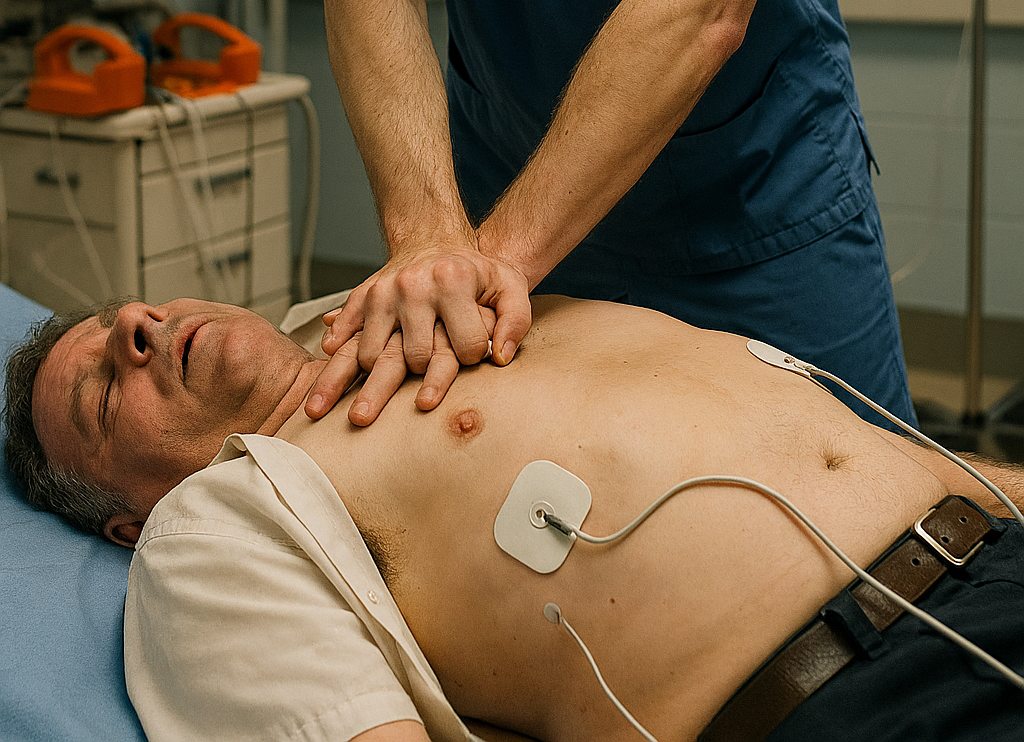
You climb onto the step and begin compressions.
Hard. Fast.
Your arms ache almost immediately.
The world narrows to the rhythm beneath your palms.
The crash team floods the room. Someone prepares the defibrillator. Someone else draws up adrenaline. You keep going until you’re relieved, stepping back breathless, sweat gathering at your collar.
A shock is delivered.
Another round of CPR.
Another shock.
Then – a pulse.
Weak, but present.
The team moves quickly to stabilise him for transfer to the cath lab. You stand at the edge of the bay, heart still racing, watching the trolley disappear down the corridor.
Only when the room falls quiet do you realise your hands are shaking.
Later, in the staff room, the adrenaline fades and the weight of the moment settles in. You replay every second — what you did, what you could have done, what might have happened if things had gone differently. You know that not every arrest ends with a pulse. You know that some will stay with you long after the shift ends.
This is the reality of medicine: moments of triumph, moments of loss, and the emotional imprint of both.